


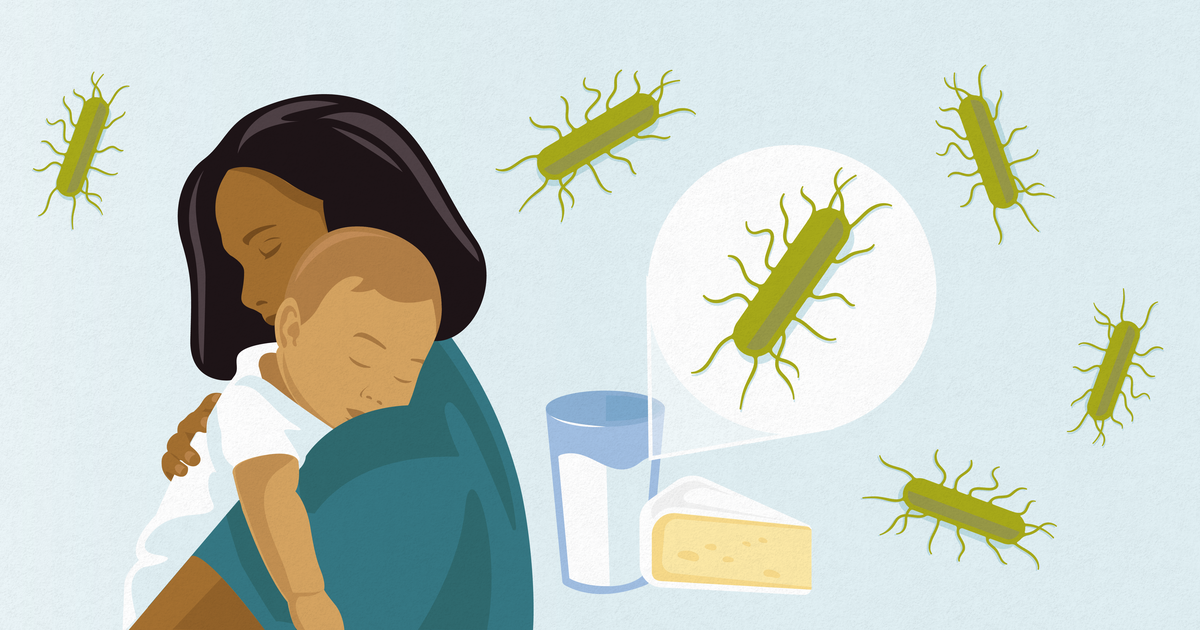
In light of a recent report by the New Mexico Department of Health (NMDOH) about the dangers of consuming raw milk, health officials recommend pregnant and breastfeeding individuals not consume soft cheeses, raw milk or any products made with raw milk, due to the risk of Listeria infection. That’s according to the NMDOH and the American College of Obstetricians & Gynecologists.
“About 1% of all soft cheeses will be affected by Listeria contamination, but if that cheese is made with raw milk, the risk triples to quadruples, and the same is true if a person were to drink raw milk during pregnancy,” said Christina Yarrington, MD, citing data from a joint report by the U.S. Food and Drug Administration and Health Canada. “The incidence of Listeria in raw milk is between 3 and 5%, and that’s not for a lack of careful handling of raw milk. It’s for the lack of that step of pasteurization.”
Yarrington is the division chief of Maternal and Fetal Medicine and an associate professor in the Department of Obstetrics and Gynecology in The University of New Mexico School of Medicine. She explained that pasteurized milk is heated then rapidly cooled to kill germs, including Listeria, and a pregnant person or new mother shouldn’t worry about drinking pasteurized milk.
Pregnant and breastfeeding individuals should also avoid deli meats, hot dogs and some pre-packaged, pre-cut vegetables, because they can also harbor Listeria, she said.


I say to my patients all the time, ‘The risk of this happening is really small, but the consequence of it is so, so heavy, that I recommend you avoid these foods.’
– Christina Yarrington, MD, Division Chief, Maternal and Fetal Medicine & Associate Professor, Department of Obstetrics and Gynecology, UNM School of Medicine
Listeria monocytogenes, or Listeria, are rod-shaped bacteria that are usually transmitted by consuming food or drinks contaminated with the organisms.
In healthy individuals, Listeria usually causes only a mild infection, but it can have disastrous consequences for a developing fetus or a newborn baby due to their lack of a fully developed immune system, Yarrington said. For example, the bacteria can get into the baby’s brain or blood.
The mother’s placenta protects the fetus from many harms, but Listeria is one of the few bacteria that can get through the placenta and cause infection, Yarrington said. Further, Listeria can pass through breast milk to a newborn baby.
“What scares me about it is when an adult, including a pregnant woman, is infected with Listeria, they’re usually not that sick,” Yarrington said. “They feel maybe a little bit fatigued, unwell, upset stomach, and when you’re pregnant, that’s your every day. But those are the only signs that something might be happening.”
Foods Pregnant and Breastfeeding Individuals Should Avoid
- Raw milk or any products made with raw milk
- Soft cheeses, such as queso fresco, brie, cottage cheese and cream cheese
- Deli meats
- Hot dogs
- Pre-packaged, pre-cut vegetables
She added that pregnant individuals may be more likely to get an infection from Listeria.
“Listeria is one of the bacteria that makes me lose sleep sometimes, because in order to protect the baby, when you’re pregnant, your immune system is a little bit different and it makes a woman more vulnerable to infections,” she said.
Commenting on the NMDOH report, which attributed the death of a newborn to a Listeria infection likely linked to the consumption of raw milk, Yarrington called the situation “heartbreaking.”
“I think it’s a tragedy any time a family loses a baby,” she said. “As horrific as it is to imagine, sometimes it happens and there’s no way anyone could have gotten ahead of it. It makes me especially sad to think that this terrible loss could be attributable to a type of bacteria that we know can be especially harmful to babies while they’re still inside their mothers, or when they’re newly out in the world.”
Due to the well-known risks of Listeria infection, Yarrington stands by the guidance to pregnant individuals and new mothers to avoid soft cheeses, raw milk and other foods that can contain Listeria.
“Thinking about this family’s loss just makes me reflect on why we give these precautions,” she said. “I say to my patients all the time, ‘The risk of this happening is really small, but the consequence of it is so, so heavy, that I recommend you avoid these foods.’”
link