
Psychometric analysis of a KAP questionnaire on green dentistry using PLS-SEM and EFA: a pilot study | BMC Oral Health

The present study is one of the first studies evaluating the psychometric properties of the KAP questionnaire to refine its subscales for use in green dental practices. The adapted instrument, derived from three original studies [6, 10, 11] supplemented with the latest sustainability guidelines from the eco-dentistry association and the center for sustainable healthcare UK, necessitates psychometric analysis [12, 13]. Original studies did not provide details on prior psychometric analysis, aside from the assessment of content validity by a limited group of faculty experts on a small participant sample [6, 10, 15]. This questionnaire was developed based on a thorough analysis of the literature, consulting with experts, and conducting pilot testing followed by vigilant psychometric analysis to assess several aspects of green dentistry. The nature of this predefined GDM model with an operational definition of themes guides the format of questions to be asked. Farhani and Suchak, pioneers of green dentistry, introduced the concept of GDM [10]. Building upon their work, Al Shatrat et al. and Agrasuta conducted KAP studies in Jordan and Thailand, respectively, by adapting this concept [6, 10, 11, 15]. The content validity of the KAP questionnaire used in Jordanian study was evaluated by a group of faculty experts at Old Dominion University and Jordanian dentists at Jordan University of Science and Technology [15]. The same KAP questionnaire was adapted by a study conducted in Thailand [6]. Following the footsteps of these three pioneer studies, several studies conducted in India used almost the same KAP questionnaire with common themes to assess green dentistry with some modifications [7,8,9]. It is challenging to validate the results of most of these studies and produce a standardized instrument because each study used the tool without a robust construct validation approach with varying approach to validity and reliability of instruments [4]. Studies in literature [7,8,9, 17] have made commendable contributions to the field by adapting and applying the GDM-based questionnaire to assess KAP in green dentistry. By acknowledging valuable insights from these prior works, this study aims to set a precedent for future research in this domain.
In the current study, using PLS-SEM, the test of VIF confirmed that the nature of our knowledge and practice model is formative particularly as the nature of items were non-interchangeable and level of collinearity within each domain remained below < 5. Typically, a lower VIF is preferred as it signifies reduced multicollinearity, leading to more stable and reliable estimates for coefficients [18]. Widely accepted rules of thumb for VIF is: value of 5 or higher indicates a potential issue with collinearity problem [19]. However, the construct validity of the formative model assessment for knowledge and practice using PLS-validity test revealed the insignificant outer weights (p-values) for latent construct of knowledge and most practice items. Of the remaining five second order constructs (subdomains), the ‘amalgam practice and radiographic practice’ had only one significant outer weight with p-value of 0.031 and 0.018 respectively. The outer weights of 4 items of 5 in ‘green procurement’ were significant. ‘Infection control’ had three of 10 items, while ‘water conservation’ had one significant outer weight of three. So, we employed a decision-making process to determine whether to retain or remove formative indicators. When an indicator’s outer weight is non-significant, but its outer loading is high (i.e. above 0.50), the indicator should be interpreted as relatively important but not as absolutely important [18]. In this situation, the indicator would generally be retained [19, 20]. However, when an indicator has a non-significant weight and the outer loading is below 0.50, the researchers should decide whether to retain or delete the indicator by examining its theoretical relevance and potential content overlap with other indicators of the same construct [19]. As a rule of thumb, (Fig. 6) shows the criterion used to retain or remove indicators in formative constructive models.
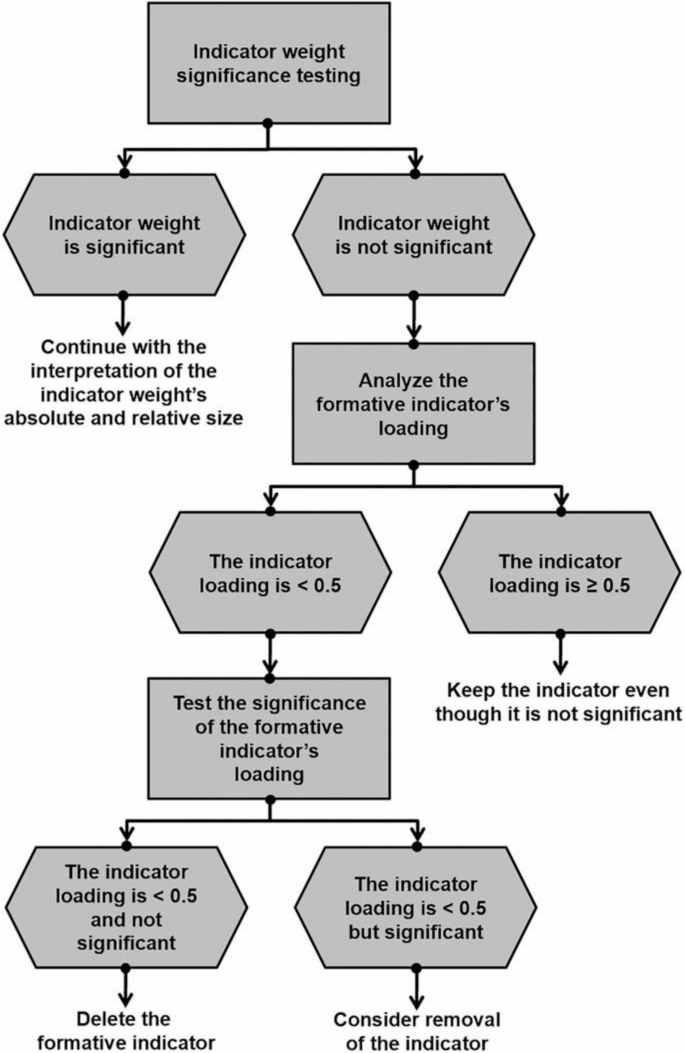
This figure illustrates the systematic approach for evaluating formative indicators, where theoretical relevance and statistical significance guide the decision to retain or delete items. Caption credit: Hair Jr JF, Hult GTM, Ringle CM, Sarstedt M, Danks NP, Ray S. Partial least squares structural equation modeling (PLS-SEM) using R: A workbook. Switzerland AG: Springer Nature; 2021, Chap. 5; Pp 91–95. Decision-making process for retaining or deleting formative indicators [20]
Since the indicators define the construct in formative a model, the domain of the construct is sensitive to the number and types of indicators representing the construct. Therefore, altering or deleting an indicator might alter the construct’s conceptual scope [21]. This was one of the reasons that item 4 in the ‘amalgam management’ domain was retained despite nonsignificant p-values for both outer weight (0.777) and outer loads (−0.442). The results of construct validity using SEM for our formative model unequivocally confirm the suitability of this approach for psychometric analysis in this context. Each indicator in a formative model contributes a unique aspect to the overall construct, traditional reliability measures, including Cronbach’s alpha, are not applicable as the focus is not on internal consistency [22]. According to Hair et al. [23] when an indicator shows a non-significant weight and lacks strong outer loading, its retention should be based on theoretical relevance and potential content overlap with other indicators of the same construct. The assessment is often more qualitative and relies heavily on conceptual rationale (operational definition of domains of GDM) and expert judgment [21]. It’s essential to build a strong theoretical foundation for a formative model and provide a compelling argument for the inclusion of each [23]. Additionally, the content validity and conducting collinearity checks are crucial to ensure the validity and reliability of a formative instrument [24]. In present study, the content validity was ensured by involving expert reviewers to confirm that the indicators comprehensively captured all relevant aspects of the construct. Collinearity checks were conducted to ensure that the indicators were distinct and contributed uniquely to the overall latent construct, avoiding redundancy or overlap.
Our results of checking the dimensionality of attitude by EFA aimed to discern the underlying factor structure within the attitude section of the questionnaire, which followed a reflective construct. The suitability of EFA was confirmed by KMO (0.734) along with significant results of the Chi-Square test and Bartlett’s Test of Sphericity supported the appropriateness of factor analysis as well as the multivariate normality of the variables. Factor loadings obtained for the three extracted factors, and each item displayed loadings above the established threshold of 0.4, confirming their reliability as indicators of the respective factors [25]. The consistent presence of loadings exceeding 0.4 across all items further strengthens the confidence in the reliability and interpretability of the identified factors, thereby affirming the robustness of the factor solution. It’s noteworthy that previous KAP studies have primarily focused on a relatively homogeneous target population [6,7,8,9, 15]. The target population for study conducted in Hyderabad and Secunderabad, Telangana, India was general practitioners [8]. Similarly other studies conducted across India including Chennai and Bangalore chose dentists as their study group [7, 9]. Initial KAP studies conducted in Canada, Thailand and Jordan also targeted public and private practitioners [6, 10, 11, 15]. In cognizance of the fact that dental hygienists and assistants may also play a significant influence in the adoption of environmentally friendly dentistry practices [26], our diverse sample of dental school personnel (dental practitioners and dental auxiliaries) and students (undergraduate and postgraduate) increases the generalizability of results and guarantees a representative viewpoint from the student and academic communities.
Crucially, this study advances the methodology used in the creation and validation of evaluation instruments for green dentistry along with adding to the expanding corpus of literature on the subject. With special attention devoted to cross-cultural adaptation as part of this psychometric analysis, particularly within the context of Pakistani culture. By ensuring that every aspect of the questionnaire’s application was meticulously considered, including linguistic nuances, cultural relevance, and socio-cultural norms using Hardman’s framework, we aimed to enhance the validation process [16]. This comprehensive approach underscores the robustness of the questionnaire’s adaptation.
While our pilot study was constrained by a small sample size, the feasibility and efficacy of our methodology are evident. Although, it may limit the generalizability of findings, however, the main objective was to assess psychometric properties of the questionnaire, not to generalize findings. A larger sample would allow for more precise estimation of paths and relationships within complex structural models. Our findings offer valuable insights for academics, practitioners, and educators by advancing the psychometric validation of predefined KAP themes in sustainable dental care.
link



:max_bytes(150000):strip_icc()/Health-GettyImages-1413749294-1e0959850fd24395b36963b6b3f2e109.jpg "What Happens to Your Muscles When You Take Amino Acid Supplements?")